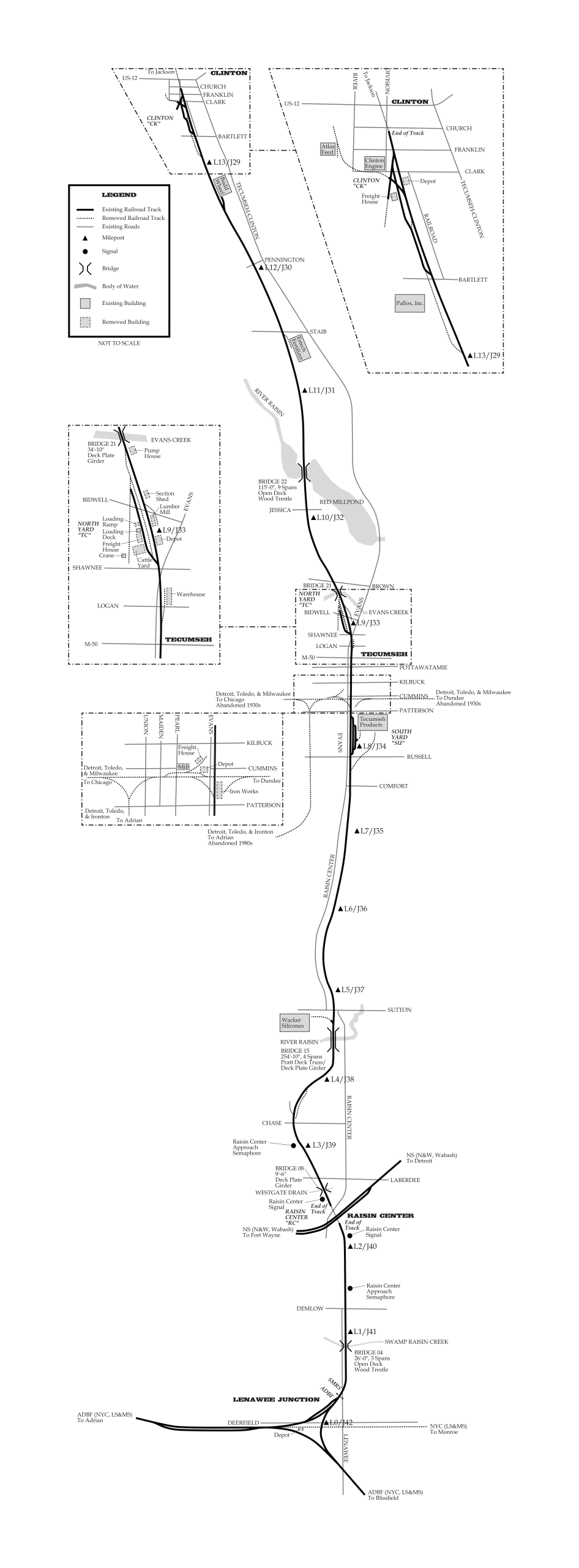
The ‘Clinton Branch’ has a long and storied history dating back to 1836 and the formation of the Palmyra & Jacksonburgh Railroad. The railroad was the first branch line laid in the State of Michigan and played a critical role in the development of the towns along the tracks. Up until abandonment in 1982, this line was a key channel for freight and industry in Lenawee County. The Southern Michigan Railroad Society was formed in 1982 with the goal of acquiring the line and creating an operating railroad museum. Visit our About the Society page to learn more about our story. Read on to learn more about how this railroad line developed and explore the remaining ‘Clinton Branch’ that we preserve today.
The History of The Clinton Branch
April, 1833
The Erie & Kalamazoo Railroad company is granted a charter by the Michigan Territorial Council to construct a new railroad from Port Lawrence on Lake Erie, which later became Toledo, OH, to Adrian, MI, in the Lenawee County of the Michigan Territory. This is the first railroad to reach the Michigan Territory from points east.
March 26th, 1836
The Palmyra & Jacksonburgh Railroad is organized, under the control of the Erie & Kalamazoo Railroad. The planned railroad will branch north off of the Erie & Kalamazoo Railroad at Palmyra, MI and extend 42 miles to Jacksonburgh, MI via Tecumseh, Clinton, and Manchester. The start of the branch will become known as Lenawee Junction.
1837
Michigan becomes a state. Construction begins.
1838
Jacksonburgh is renamed to Jackson. Construction to Tecumseh is completed and the first train arrives in Tecumseh at Milepost 9. Funding has run out and construction on the branch line stops. The first services are a series of wagons pulled by horses along wooden rails. The railroad owns two passenger wagons and eight freight wagons.
1844
The Palmyra & Jacksonburgh Railroad goes bankrupt and the line is sold to the State of Michigan to be operated by the Michigan Southern Railroad.
1849
The State of Michigan sells the line to the Michigan Southern Railroad. With funding restored, construction resumes northward.
1852
The Michigan Southern completes a railroad line that crosses southern Michigan and connects to Chicago, IL.
1853
The railroad reaches Clinton at Milepost 13.5 on the last day of 1853.
1854
The first railroad station is built in Tecumseh at Milepost 9.
1855
The railroad reaches Manchester.
1856
The railroad reaches Jackson at Milepost 42.5, connecting with the Michigan Central Railroad. The Jackson Branch is complete, creating the first rail connection between Lake Erie and Jackson.
April 16th, 1869
The Michigan Southern Railroad merges with the Lake Shore Railroad to form the Lake Shore & Michigan Southern Railroad. Later in the year, the railroad merges with the Buffalo & Erie Railroad, creating a connection into New York. Combined with the existing Michigan Southern infrastructure, railroad connections now stretch from New York to Illinois.
1877
Cornelius Vanderbuilt’s New York Central & Hudson River Railroad acquires control of the Lake Shore & Michigan Southern Railroad.
June, 1910
President William Howard Taft travels over the line enroute to Jackson to celebrate the founding of the Republican Party. The train stops in Tecumseh and President Taft gives a five minute speech from the back of his passenger car to a crowd gathered on Chicago Boulevard.
December 22nd, 1914
The Lake Shore & Michigan Southern Railroad merges with the New York Central & Hudson River Railroad to become the New York Central Railroad.
1918
Following several accidents at the Chicago Boulevard railroad crossing, the City of Tecumseh requires trains to obey the highway traffic signals at the intersection. This is the only place in North America where this condition exists.
1920
The line is upgraded to 105 pound rail, most of which remains in place today.
September 14th, 1938
The last scheduled passenger train crosses the line. Operated by a diesel powered “doodlebug,” some passengers ride over the line one last time for fun, arranging for friends to pick them by automobile further down the line. The automobile is rapidly taking both passenger and freight traffic away from trains.
1959
The full branch line from Palmyra to Jackson is in service for the last time.
1963
Tracks are abandoned between Manchester and Jackson. The line is renamed the Manchester Subdivision.
1965
Tracks are abandoned between Manchester and Clinton. The line is renamed the Clinton Branch.
February 1st, 1968
The New York Central Railroad merges with the Pennsylvania Railroad to form the Penn Central Railroad.
April 1st, 1976
The Penn Central Railroad is bankrupt. Conrail is formed to take over operations of several bankrupt railroads, including the Penn Central. The line is renamed the Clinton Secondary.
December, 1980
Budd Wheel in Clinton, the largest customer on the line, ends rail shipments. The daily Clinton Local train service ends. Service continues on an as-needed basis.
November 16th, 1981
Conrail files to abandon the Clinton Secondary between Lenawee Junction and Clinton. The last two remaining customers on the line are Tri Count Logging and the Pallox Company, both in Clinton.
March 7th, 1982
The final loaded freight cars are delivered to Pallox.
March 11th, 1982
The final Conrail train crosses the line, retrieves seven empty freight cars, and concludes rail service on the Clinton Branch.
August 10th, 1982
The Southern Michigan Railroad Society is formed by local school students with the hope of acquiring the Clinton Branch for preservation.
October 1st, 1982
Norfolk & Western Railway removes the diamonds at Raisin Center. The northernmost 11 miles of the line are severed from the general railroad system.
1984
The Southern Michigan Railroad Society begins negotiations with Conrail to purchase the line.
1985
The Southern Michigan Railroad Society purchases the line from Conrail. Our story begins.
The Remaining Clinton Branch